
Access a comprehensive library of cybersecurity research, whitepapers, frameworks, toolkits, and expert insights on AI-driven security, cloud governance, data privacy, risk management, and emerging technologies curated by CyBe and the CSA Bangalore Chapter.
A global study highlighting the widening cybersecurity talent gap and its impact on organizations. The report explores key skill shortages, industry challenges, and practical strategies to build a future-ready workforce.
This research study captures insights from over 100+ CISOs, CIOs, and CTOs on the current and future use of Artificial Intelligence (AI) in cybersecurity operations. It investigates how AI is transforming security operations centers (SOCs), threat detection, incident response, and risk management.
The study recommends establishing AI governance frameworks, continuous model risk assessments, and AI supply chain security practices to manage risks effectively while leveraging AI’s potential.
A comprehensive global benchmarking study evaluating the cloud security and technology maturity posture of enterprises across multiple industries and regions. It assesses organizations’ readiness in areas like cloud governance, Zero Trust implementation, SaaS security, and incident response.
Only 34% of surveyed enterprises achieved a mature level of cloud security governance and visibility.
56% have implemented Zero Trust partially, mainly focused on identity and access management.
The report proposes a phased cloud security maturity model, offering actionable recommendations for organizations to progress from ad-hoc practices to advanced, automated, and predictive security operations.
This regulatory mapping project aligns CSA’s Cloud Controls Matrix (CCM) v3.0.1 with the Reserve Bank of India’s Gopalakrishna Committee (GKC) recommendations on IT and cybersecurity governance in financial services.
113 cloud security controls from the CSA CCM mapped to 12 RBI GKC focus areas, covering domains like data protection, access control, incident response, and business continuity.
Provides a regulatory compliance framework for banks and fintech companies adopting cloud services under RBI oversight.
CSA Bangalore recommends future alignment with CCM v4.0 and other emerging regulatory advisories in India’s financial sector.
The Global Cybersecurity Skills Gap Report 2025 by CyBe (CSA Bangalore Chapter) highlights the growing shortage of skilled cyber professionals impacting organizations worldwide.
With insights from 1,000+ leaders across industries, the report reveals a 4.8 million global workforce gap, increasing risk and slowing innovation. It identifies critical shortages in AI, cloud security, and key operational roles, along with gaps in essential soft skills.
The study emphasizes the need for hands-on learning, certifications, and stronger industry–academia collaboration to build a future-ready cybersecurity workforce.
The survey received over 150 responses, with a well-balanced representation of 45% from CXOs and 55% from their direct reports. The survey was structured into nine distinct sections, each focusing on different dimensions of AI for cybersecurity, including strategy, trends, challenges, innovation, impact on costs, regulation, and best practices.
Explore cutting-edge research on how artificial intelligence is transforming cybersecurity—enhancing threat detection, automating responses, and redefining digital defense strategies for modern enterprises.
CyBe Global
Founder & President
Sub-Editor
Head – Research and
Innovation, CSA
Bangalore Chapter
Nidhi Varshney Singhai
Pradeep Kumar
Anju Gupta
Dr. Anand Ellur
Seema Khandelwal
Madhukeshwar Bhat
Anand Kumar Jha
Prem Kumar
Satyavathi Divadari
Pooja Agrawalla
Dr. Keerthan Raj
Nagammai shanmugham
Dr Ramkumari H Iyer
Shashank Gidbidi
Mahesh T
The research survey was conducted by the CSA Bangalore Chapter in association with Karnataka Digital Economic Mission (KDEM) aimed to gather insights from CXOs and their direct leadership across a diverse range of global industries, including BFSI, Healthcare, IT, IT Enabled Services, Manufacturing, Telecom & Media, EdTech, and others.
The survey received over 150 responses, with a well-balanced representation of 45% from CXOs and 55% from their direct reports. The survey was structured into nine distinct sections, each focusing on different dimensions of AI for cybersecurity, including strategy, trends, challenges, innovation, impact on costs, regulation, and best practices.
Deep dive into frameworks, maturity models, and best practices that help organizations build resilient, scalable, and secure cloud ecosystems in an increasingly complex threat landscape.
CyBe Global
Founder & President
Cyber Security Ambassador
Anand Kumar Jha
Satish Muniyan
Dr(Lt Col) Prasad S. N.
Dr. Anand Ellur
Dr.Anand Sasikumar
Dr. Ravikumar V
Dr. Vartika Sharma
Spoorthi M
The goal of this survey is to better understand the maturity levels of organizations for the cloud and technology both currently and in the near future.
Key areas of interest include:
The survey received over 150 responses, with a well-balanced representation of 45% from CXOs and 55% from their direct reports. The survey was structured into nine distinct sections, each focusing on different dimensions of AI for cybersecurity, including strategy, trends, challenges, innovation, impact on costs, regulation, and best practices.
Insights from industry-led frameworks and policy research that guide organizations in strengthening governance, ensuring compliance, and building robust cybersecurity strategies at scale.
Josh Buker
Sean Heide
Alex Kaluza
Shamun Mahmud
John Yeoh
The CSA CCM v3.0.1 Addendum provides a structured mapping between the Cloud Security Alliance’s Cloud Controls Matrix (CCM) and the Reserve Bank of India’s (RBI) Gopala Krishna Committee (GKC) Report on Information Security, Electronic Banking, Technology Risk Management, and Cyber Frauds.
This document helps organizations align RBI compliance requirements with global cloud security standards by identifying control mappings, analyzing gaps, and highlighting areas requiring additional controls. It serves as a practical guide for strengthening security frameworks and ensuring regulatory compliance.
Understand the growing talent shortage in cybersecurity and explore actionable insights to build, upskill, and retain a future-ready workforce in the digital age.
Ajay Rentala
Krishna Kishore
Madhav Chabalani
Manjesh G Pai
Manju Lalwani
Priyanka S
Satyavathi Divadari
Sivaram I
Sohit Raina
Yogesh G
Top Challenges are:
Grow trends observed are:
Grow trends observed are:
Meet the cybersecurity leaders, researchers, and industry experts shaping the knowledge shared through CyBe resources.
Release Date: 11/27/2019
This document contains a mapping and gap analysis between the cloud security requirements of CCM V3.0.1 and those of the Reserve Bank of India (RBI)’s Gopala Krishna Committee (GKC) Report, on Information Security, Electronic Banking, Technology Risk management & Cyber Frauds.
The document aims to help organizations adhering to the aforementioned RBI’s document to also meet CCM requirements. This is achieved by identifying compliance gaps in the RBI’s document in relation to the CCM.
CSA Bangalore
Cloud Security Alliance
Ajay Rentala
Ekta Mishra
Haojie Zhuang
Krishna Kishore
Manjesh Pai
Manju Lawani
Priyanka S
Satyavathi Divadari
Sivaram I
Sohit Raina
Victor Chin
Yogesh G
The RBI constituted the Working Group on Information Security, Electronic Banking, Technology Risk Management and Cyber Frauds, which produced its report in January 2011.
The Working Group was headed by Mr. G. Gopala Krishna and is popularly known as the Gopalakrishna Committee Report.
CSA Bangalore Research working group has taken a Cloud Control Matrix(CCM) and Gopalakrishna Committee report, blended it together and prepared a mapping document.
This document contains a mapping and gap analysis between the cloud security requirements of CCM V3.0.1 and those of the Reserve Bank of India (RBI)’s Gopala Krishna Committee (GKC) Report, on Information Security, Electronic Banking, Technology Risk management & Cyber Frauds.
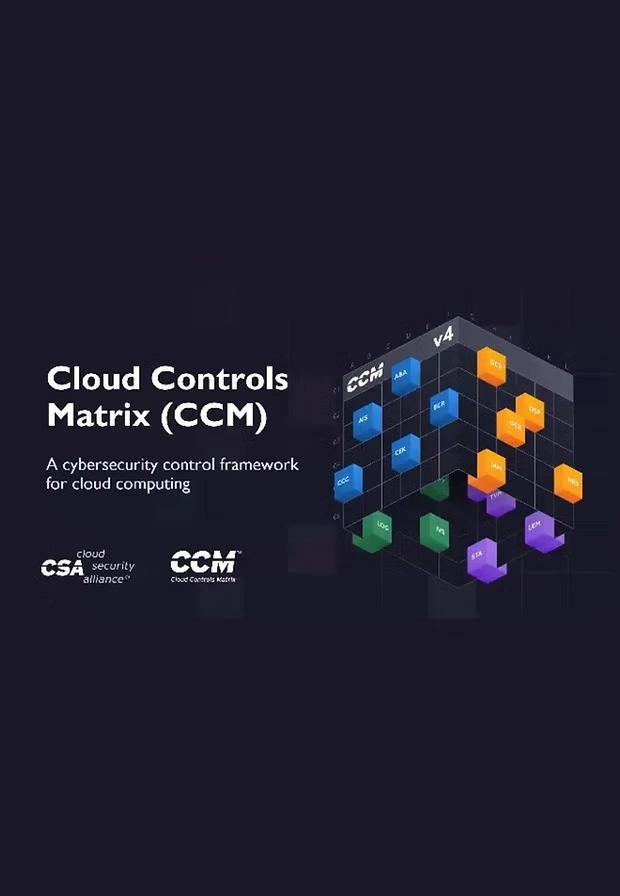
The CSA Cloud Controls Matrix (CCM) is a cybersecurity control framework for cloud computing.
It is composed of 197 control objectives that are structured in 17 domains covering all key aspects of cloud technology.
The controls framework is aligned to the CSA Security Guidance for Cloud Computing, and is considered a de-facto standard for cloud security assurance and compliance.
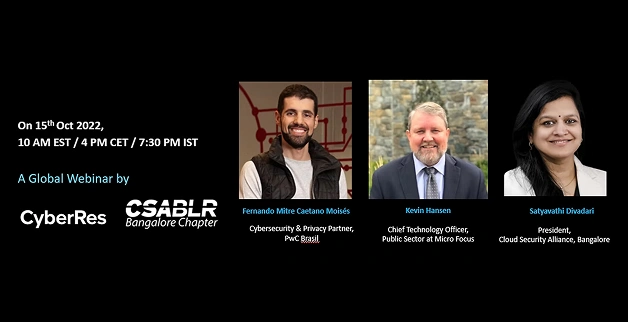
Organizations are discarding the model of “Trust but Verify” and moving toward a zero trust model. That is, “Never Trust,
Panelists Name :
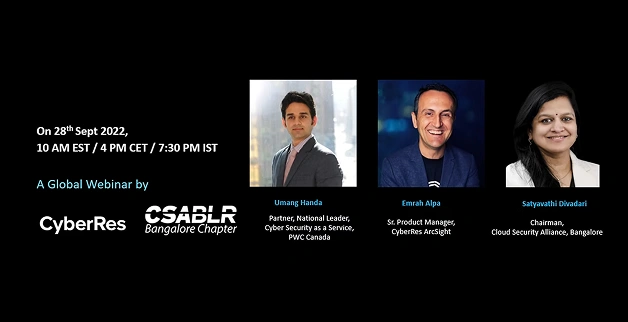
Explosive growth of digitization and cloud adoption increased the threat landscape across different sources that include cloud, IoT, edge computing
Panelists Name :
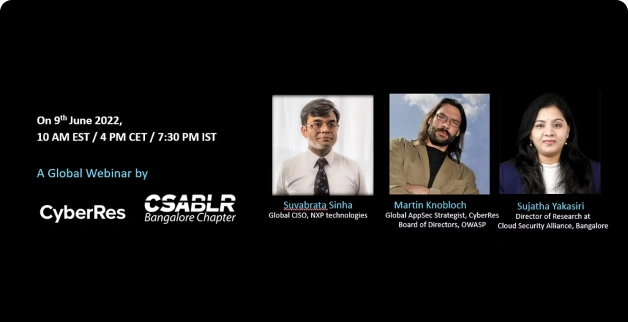
Application security continues to evolve from shifting left to shifting everywhere as we move further into a cloud-driven era. Learn
Panelists Name :
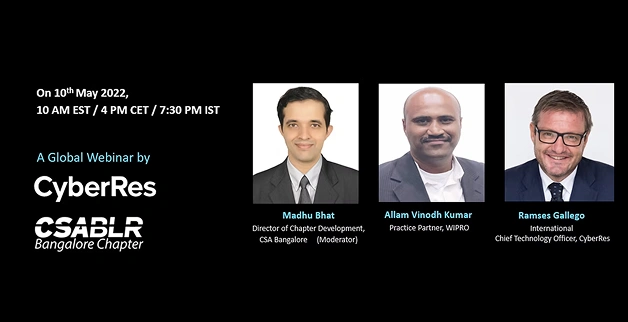
Do you want to know how to take competitive advantage of multi-cloud while managing privacy and security effectively and efficiently?
Panelists Name :